


Ghana has announced a $10 billion investment programme covering 2027 to 2030, with plans to expand domestic manufacturing, agricultural production and exports as the country enters a new phase of economic development following its International Monetary Fund-supported recovery. The four-year initiative, known as the New Economy Programme, will direct public investment towards productive industries and infrastructure, with the government allocating GH¢30 billion for its first year.
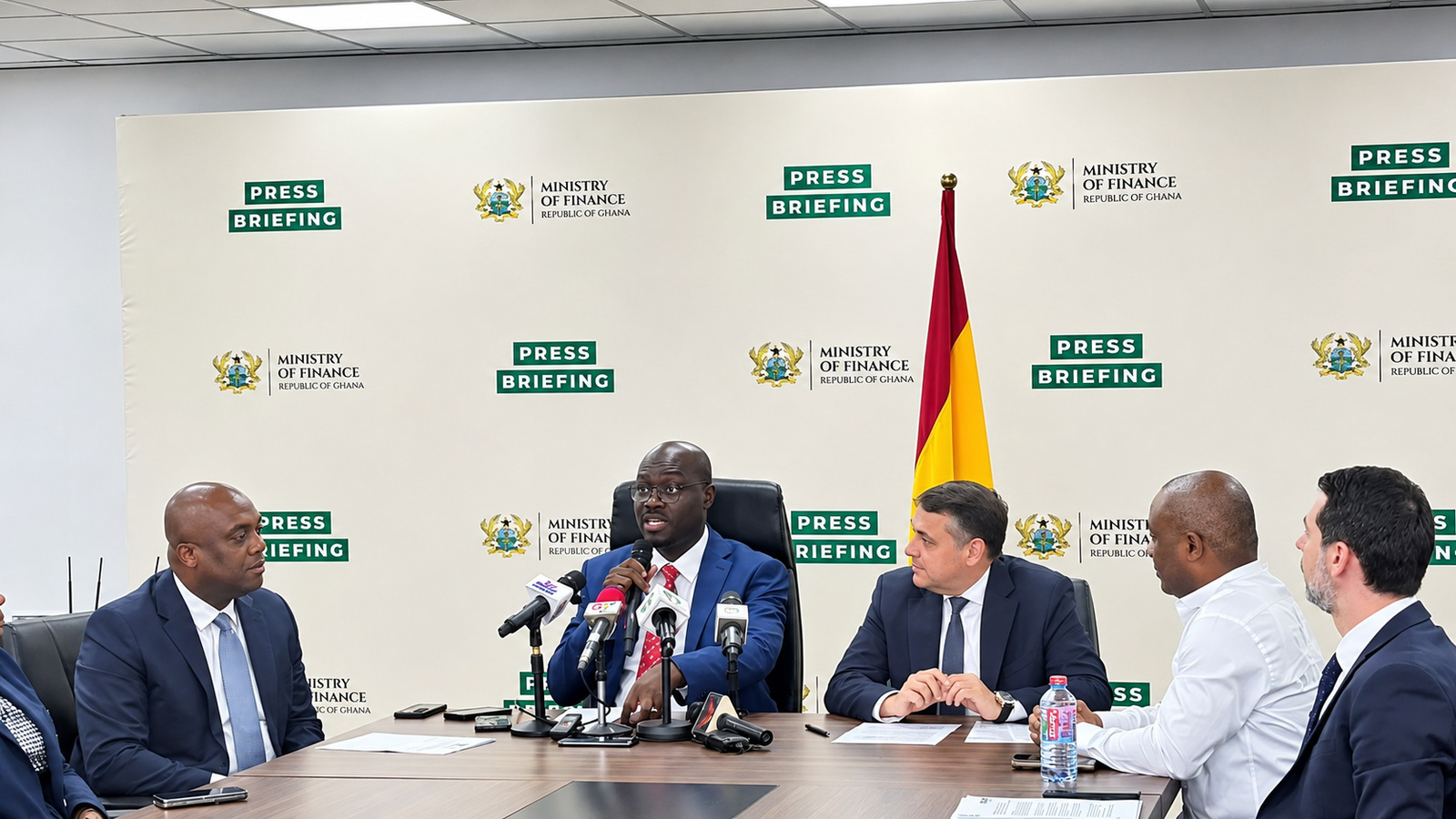
According to Reuters, Finance Minister Cassiel Ato Forson presented the programme to Parliament in Accra on November 12, 2026, alongside a budget projecting economic growth of 5.2% in 2027. The announcement comes after Ghana completed its $3 billion IMF lending programme, introduced during a period of severe debt and inflation pressures.
The Ghana New Economy Programme represents an attempt to translate economic stabilisation into productive investment. Its success will depend on how effectively public funding supports private businesses, expands local processing capacity and creates employment opportunities.
Ghana’s $10 Billion Investment Plan Targets Industrial Production
Ghana’s new economic strategy focuses on a longstanding challenge: the country’s dependence on exporting commodities while importing a substantial range of manufactured and processed products.
Gold, cocoa and petroleum have historically played important roles in the country’s export economy. Although these resources generate foreign exchange, exporting raw materials can limit the amount of manufacturing activity and employment associated with their production.
The government wants to address this imbalance through eight interconnected areas of investment.
These include commercial agriculture, energy infrastructure, critical minerals processing, textiles and garments, pharmaceuticals, technology, tourism and creative industries, alongside measures to strengthen financial stability and access to affordable credit.
The programme is intended to create stronger connections between these sectors.
Agricultural production, for example, can supply raw materials to food processors, while energy infrastructure can support factories that require dependable electricity.
Technology investment can improve productivity and create opportunities for businesses supplying digital services.
The central objective is to increase the proportion of economic activity taking place within Ghana before products reach domestic consumers or international markets.
However, the programme remains a government investment commitment. Its announcement does not establish that the proposed factories, infrastructure projects or employment opportunities have already materialised.
Ghana’s 2027 Budget Sets Aside GH¢30 Billion for Economic Transformation
A distinguishing feature of the Ghana New Economy Programme is its proposed domestic financing structure.
The government plans to allocate GH¢30 billion, equivalent to approximately 1.5% of GDP, to the programme in 2027.
Over four years, the proposed investment totals approximately $10 billion, or an average of $2.5 billion annually.
Finance Minister Cassiel Ato Forson outlined two principal financing measures.
The first involves reducing Ghana’s primary fiscal surplus target from 1.5% of GDP to 0.5%, releasing the equivalent of one percentage point of GDP for productive investment.
The second involves additional revenue generated through tax reforms and stronger compliance, expected to contribute another 0.5% of GDP.
The government says this approach will allow it to finance the programme without contracting new loans specifically for the initiative.
This distinction matters because Ghana recently experienced a debt crisis that restricted government spending and required international financial assistance.
The financing plan nevertheless carries execution risks.
Revenue collection must perform as expected, while government spending must remain consistent with its fiscal commitments.
The proposed investment will also need transparent project selection and oversight to ensure that public resources produce measurable economic benefits.
The 2027 budget commits to project appraisal and value-for-money assessments, but the effectiveness of those measures will depend on implementation.
Agriculture and Manufacturing Could Determine the Programme’s Economic Impact
Agriculture is one of the most important sectors in Ghana’s development strategy because of its contribution to employment, food production and exports.
The government’s broader budget framework proposes $3 billion for commercial agriculture under the New Economy Programme.
The objective is to strengthen agricultural production and support more commercially organised value chains.
Greater investment in processing facilities could allow Ghanaian businesses to convert agricultural commodities into finished products for local consumption and export.
Cocoa provides a useful example.
Ghana is internationally recognised as a major cocoa producer, but the economic opportunities associated with chocolate and other processed cocoa products extend into manufacturing, packaging, branding and distribution.
Increasing domestic processing could allow more of those activities to take place within the country.
However, expanding processing capacity requires more than investment in factories.
Businesses need reliable access to raw materials, competitive financing, electricity, transport infrastructure and customers capable of sustaining production.
Similar conditions apply to textiles and garments, where domestic manufacturing must compete with established international suppliers.
The Ghana New Economy Programme could create opportunities for industrial businesses, but its long-term contribution will depend on the commercial viability of individual projects.
Investment that produces goods at competitive prices and attracts sustained demand is more likely to generate lasting employment than facilities that struggle to operate after construction.
Don’t Miss This:
Ghana’s Economic Recovery Creates a New Fiscal Test
The investment announcement comes after a period of considerable economic adjustment.
Ghana sought IMF assistance in 2022 as rising debt-servicing costs, global economic disruptions and domestic fiscal pressures contributed to a severe financial crisis.
Inflation reached 54.1% in December 2022, sharply reducing household purchasing power and increasing business operating costs.
The subsequent $3 billion IMF programme supported reforms intended to restore economic stability and improve public finances.
Ghana completed that lending programme in 2026.
Inflation had declined to 3.2% in March 2026 before moving higher again in subsequent months.
The 2027 budget projects economic growth of 5.2%, compared with 4.8% in 2026, and a reduction in the cash fiscal deficit from 4% to 3.6% of GDP.
The government is also targeting inflation within a range of 6% to 10%, centred on 8%.
These figures are forecasts and policy targets, not guaranteed outcomes.
They indicate that the government intends to maintain fiscal discipline while directing more resources towards industrial development.
This creates an important policy challenge: Ghana must increase productive public investment without recreating the debt and spending pressures that contributed to its previous crisis.
The country is continuing its engagement with the IMF through a three-year Policy Coordination Instrument.
Unlike the completed lending programme, this arrangement does not provide new IMF financing. It involves policy monitoring and regular assessments that can support confidence in Ghana’s economic management.
Early Debt Repayment Signals Ghana’s Changing Financial Priorities
Alongside the investment programme, Ghana announced plans to retire more than GH¢36 billion in debt ahead of schedule.
The government said it would redeem GH¢29 billion in Domestic Debt Exchange Programme bonds originally due in February 2027, with the early repayment taking immediate effect.
It also plans to repay a restructured Eurobond by December 31, ahead of its January 2027 maturity.
The debt repayment announcement is significant because Ghana’s earlier restructuring process affected creditors and became an important part of its economic recovery.
Reducing outstanding obligations can ease future repayment requirements, although the financial benefits depend on the terms of the debt and the resources used for repayment.
Early redemption also requires careful cash management.
The government’s ability to fund industrial investment while meeting debt obligations will therefore remain an important measure of the new budget’s sustainability.
The debt announcements should not be interpreted as evidence that Ghana has eliminated its debt burden.
They represent planned and announced repayments within a broader fiscal strategy.
Cassiel Ato Forson and John Mahama Lead Ghana’s Economic Transition
Finance Minister Cassiel Ato Forson is overseeing the budget framework supporting Ghana’s proposed shift towards domestic production.
His role includes establishing the fiscal arrangements through which the government intends to finance investment while maintaining economic stability.
The programme is also part of the economic agenda of President John Dramani Mahama, whose administration has identified job creation and industrial development as central priorities.
Preparations were underway before the November budget announcement.
In September 2026, Ghana’s Ministry of Finance reported that Forson had begun consultations with the Ministry of Trade, Agribusiness and Industry, led by Elizabeth Ofosu-Adjare, on the programme’s implementation.
Those discussions are relevant because industrial transformation requires coordination between economic policymakers and the institutions responsible for trade, agriculture and manufacturing.
The government’s role will include providing infrastructure and establishing conditions that allow private enterprises to invest and expand.
However, the private sector’s response will be equally important.
Businesses will need to assess financing costs, market opportunities, regulatory conditions and the commercial prospects of the proposed industries before committing capital.
What This Means For Africa
Ghana’s proposed $10 billion investment programme highlights an important question facing many African economies: how to convert natural resources and economic recovery into stronger domestic industries.
The Ghana New Economy Programme places greater emphasis on processing raw materials locally, expanding manufacturing and creating employment through productive investment.
This approach is relevant across a continent where several economies depend heavily on commodity exports but capture a smaller share of the value associated with finished products.
Agricultural processing, critical minerals and manufacturing offer opportunities to expand the range of products African businesses can supply to domestic and international customers.
Ghana’s strategy also has potential implications for regional trade under the African Continental Free Trade Area, whose Secretariat is headquartered in Accra.
If Ghanaian manufacturers increase their production capacity and competitiveness, regional markets could provide additional opportunities for exports.
However, the existence of a continental trade agreement does not guarantee demand for products that are expensive to manufacture or difficult to transport.
Businesses must still meet quality requirements, manage logistics and compete on price.
The proposed programme also offers a test of domestically financed industrial development following an IMF-supported recovery.
Its financing structure is designed to redirect fiscal resources towards productive investment while limiting new borrowing for the initiative.
That approach could provide lessons for other African governments seeking to expand infrastructure and industry without undermining debt sustainability.
The risks are equally relevant.
Poorly selected projects, weak revenue collection or inefficient implementation could reduce the economic benefits of substantial public spending.
Ghana’s experience will therefore be measured by more than the amount of money allocated.
The important outcomes will include the businesses that expand, the products manufactured locally, the exports generated and the jobs sustained over time.
The 2027 budget establishes the government’s intended direction. The next four years will determine how much of that ambition becomes productive economic activity.
Don’t Miss This:
Jackie Appiah: How the Ghanaian Actress Built a Lasting African Film Career Across 2 Decades
Image Credit: Business & Financial Times [Ghana]